class Residual(nn.Module):
    """The Residual block of ResNet models."""
    def __init__(self, num_channels, use_1x1conv=False, strides=1):
        super().__init__()
        # No conv biases: the batch normalization after each conv removes them
        self.conv1 = nn.LazyConv2d(num_channels, kernel_size=3, padding=1,
                                   stride=strides, bias=False)
        self.conv2 = nn.LazyConv2d(num_channels, kernel_size=3, padding=1,
                                   bias=False)
        # Auto-enable 1x1 conv when downsampling so the residual shape matches.
        if use_1x1conv or strides != 1:
            self.conv3 = nn.LazyConv2d(num_channels, kernel_size=1,
                                       stride=strides, bias=False)
            self.bn3 = nn.LazyBatchNorm2d()
        else:
            self.conv3 = None
        self.bn1 = nn.LazyBatchNorm2d()
        self.bn2 = nn.LazyBatchNorm2d()

    def forward(self, X):
        Y = F.relu(self.bn1(self.conv1(X)))
        Y = self.bn2(self.conv2(Y))
        if self.conv3:
            X = self.bn3(self.conv3(X))
        Y += X
return F.relu(Y)入れ子の関数クラスによる単調改善の保証
理論的枠組み
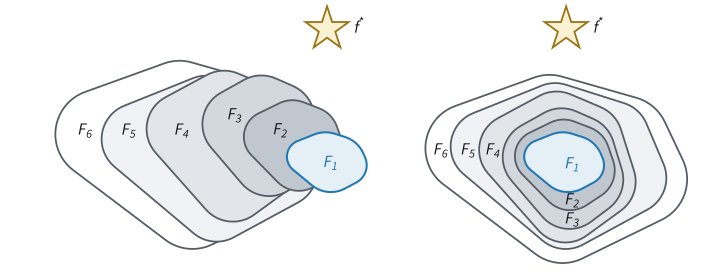
モデル族の系列 \mathcal{F}_1, \mathcal{F}_2, \ldots, \mathcal{F}_K で目標写像 f^* を近似することを考える
- 入れ子でないクラス(\mathcal{F} \not\subseteq \mathcal{F}'):既存の写像を保たずに層を拡張すると、クラス全体が f^* から遠ざかる恐れがある
- 入れ子のクラス(\mathcal{F} \subseteq \mathcal{F}'):達成可能な最良の損失が深さによって悪化しないことを保証する \mathcal{F} \subseteq \mathcal{F}' \implies \min_{f \in \mathcal{F}'} L(f) \le \min_{f \in \mathcal{F}} L(f)
- 最適化ギャップ:プレーンな層 \textrm{ReLU}(\textrm{BN}(\mathbf{W}\mathbf{x})) は \mathbf{x} を \mathbf{x} \ge 0 上で表現できるため理論上は入れ子だが、恒等写像が扱いにくい内部の重み配置にあり SGD が到達できない
残差ブロック:恒等写像への補正の学習
残差ブロック
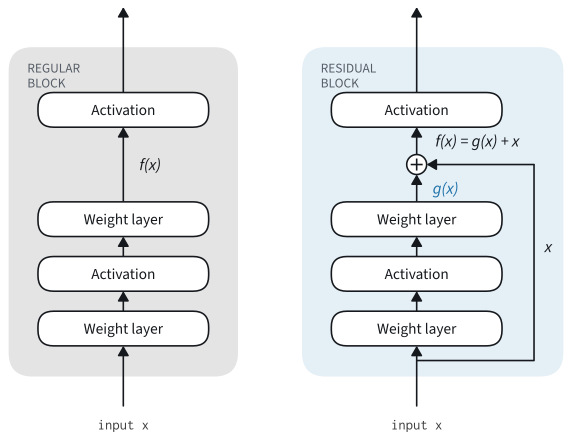
積み重ねたブロックに目的の写像 f(\mathbf{x}) を直接パラメータ化させる代わりに、残差ブロックは残差による補正 g(\mathbf{x}) = f(\mathbf{x}) - \mathbf{x} を学習し、ショートカット接続で入力を足し戻す
- 原点に位置する恒等写像(g(\mathbf{x}) = \mathbf{0}): f(\mathbf{x}) = \mathbf{x} + g(\mathbf{x})
- 恒等写像への誘導が容易:ブロックの変換を \mathbf{x} にするには、残差分岐の重み(または最終バッチ正規化の \gamma_2, \beta_2)をゼロに近づけて g を消すだけでよい
- 恒等写像まわりのプレコンディショニング:g(\mathbf{x}) \neq \mathbf{0} のときでも、\mathbf{x} の周囲の小さな摂動的補正を学習する方が、恒等写像に近い座標変換全体をゼロから学習するよりはるかに条件がよい
恒等ショートカットと 1×1 射影ショートカット
ブロックのトポロジー
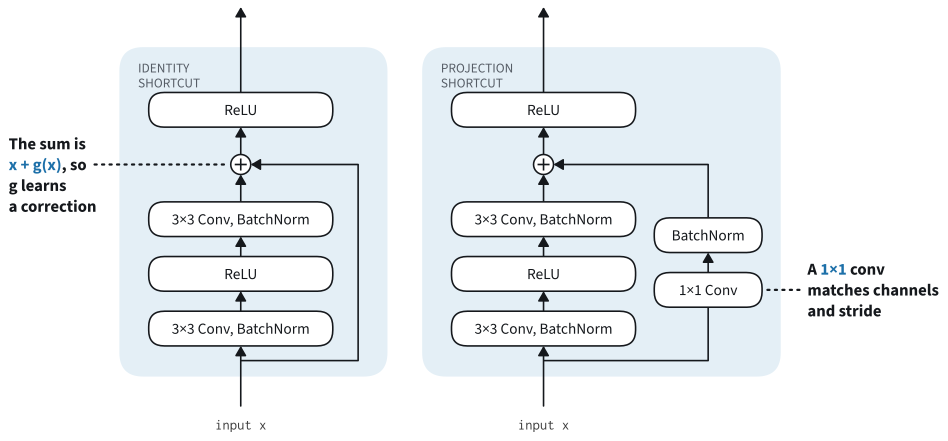
ResNet の基本的な Residual ブロックはバイアスなしの 2 つの 3\times 3 畳み込みとバッチ正規化を積み重ね、2 番目の ReLU の前でショートカットを加算し、次元が変わるときは 1\times 1 射影を用いる
- 恒等ショートカット(左、同一形状):c_{\textrm{o}} = c_{\textrm{i}} かつストライド s = 1 のとき、\mathbf{x} を追加パラメータなしでそのまま加算する
- 射影ショートカット(右、ダウンサンプリング):c_{\textrm{o}} \neq c_{\textrm{i}} またはストライド s = 2 のとき、ストライド s の 1\times 1 畳み込みとバッチ正規化で \mathbf{x} を射影し、空間サイズとチャネル幅を揃える
- 分岐ゼロ条件:2 番目のバッチ正規化で \gamma_2 = \beta_2 = 0 とすると訓練時・評価時ともに残差分岐がゼロになり、\textrm{ReLU}(\mathbf{x}) = \mathbf{x}(\mathbf{x} \ge 0 のとき)が復元される
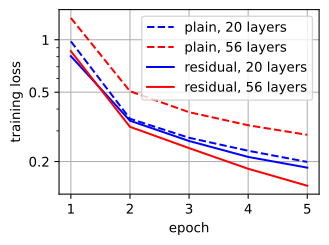
対照実験:20 層と 56 層のプレーンネットおよび ResNet
劣化の再現
28\times 28 の Fashion-MNIST 上で劣化を明確に検証するため、DeepNet(6n+2 層:16 チャネルの 3\times 3 ステム、幅 16・32・64 で各 n ブロックの 3 ステージ、プーリング付き線形ヘッド)を構築し、plain_block と Residual を n=3(20 層)および n=9(56 層)で比較する
- プレーンネットワークの劣化(損失 56 > 20):56 層のプレーンネットワーク(赤破線)は全エポックで 20 層のプレーンネットワーク(青破線)より厳密に上に位置し、最終的な訓練損失は 0.25\text{--}0.30 対 0.20 となる
- 残差ショートカットによる順序の逆転(損失 56 < 20):幹のパラメータを 1 つも増やさずにショートカットを加えるだけで、56 層の ResNet(赤実線)は 0.15\text{--}0.17 まで下がり、20 層の両モデル(\approx 0.19)を上回る
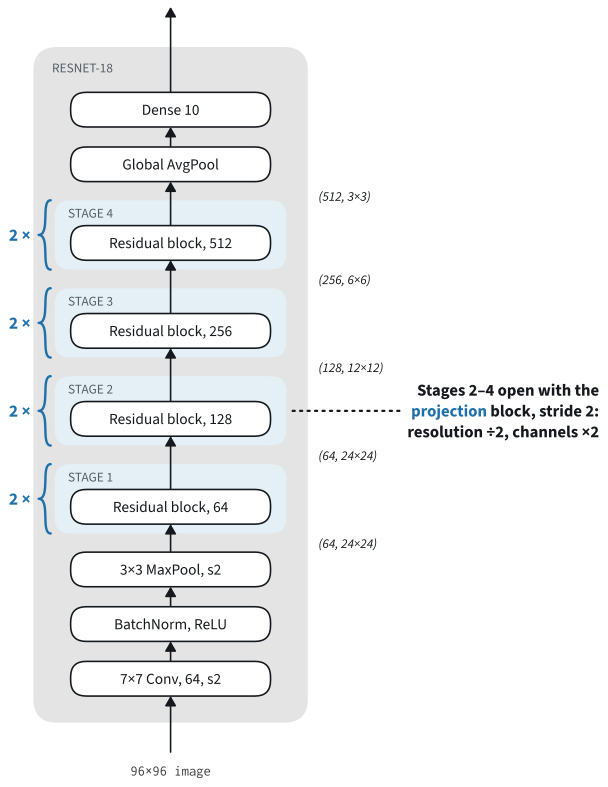
ResNet-18 の構造:ステム、4 ステージ、プーリング付きヘッド
ResNet-18 の構造
本格的なスケールでは、ResNet は GoogLeNet のステム・ボディ・ヘッドのテンプレート内に 4 つの残差ステージを組み込む
- 4× ダウンサンプリングステム(重み層 1):64 チャネルでストライド 2 の 7\times 7 畳み込み(p=3)+ バッチ正規化 + ReLU + ストライド 2 の 3\times 3 最大プーリング(p=1)により 96\times 96 \to 24\times 24 へ写像
- 4 つの残差ステージ(重み層 16):各ステージが 2 つの
Residualブロックを幅 (64, 128, 256, 512) で積み重ねる。ステージ 1 は 24\times 24 を保ち、ステージ 2〜4 はストライド 2 の射影ブロックで始まる(24 \to 12 \to 6 \to 3) - プーリング付きヘッド(重み層 1):グローバル平均プーリング + 512 \to 10 の線形層(計 1 + 16 + 1 = 18 層、1,118 万パラメータ)
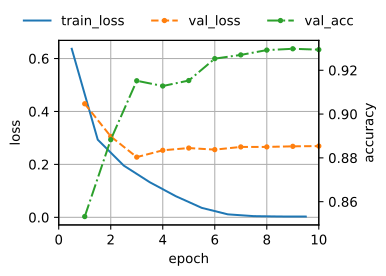
Fashion-MNIST における ResNet-18 の訓練
実験結果
すべての畳み込みの後にバッチ正規化が続くため、ResNet-18 はピーク学習率 \eta_0 = 0.1 で 10 エポックにわたり 96\times 96 の Fashion-MNIST 上で安定して訓練できる
- VGG から重みを 4\times 削減して高い正解率:検証正解率 \approx 93\% に 11.2\text{M} パラメータ(積和演算 319\text{M} 回、96\times 96 入力)で到達し、4 分の 1 幅の VGG(43.1\text{M} パラメータ、224\times 224 入力)に匹敵
- 現代的な正則化なしでの暗記ギャップ:ResNet-18 は訓練損失を 0.01 未満に下げる一方、検証損失は 0.27 付近で頭打ちとなり、§7.6 のデータ拡張・正則化レシピの動機となる
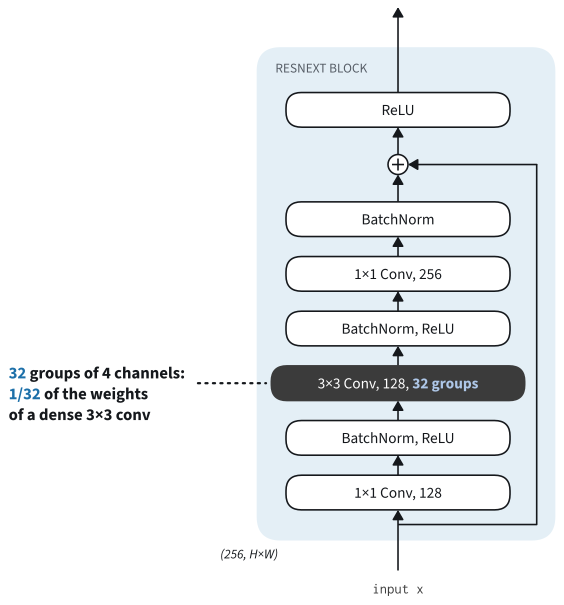
ResNeXt:グループ畳み込みによるボトルネックの広幅化
ResNeXt とカーディナリティ
チャネル幅を 2 倍にすると通常の密な畳み込みのコスト(c_{\textrm{i}} c_{\textrm{o}} k^2)は 4 倍になる。ResNeXt(Xie et al., 2017)は 3\times 3 畳み込みを g 個の独立したグループ(カーディナリティ)に分割し、同等のコストで内部のボトルネック幅を広げる
- グループ化 3\times 3 による削減:b 個のボトルネックチャネルを g 個のグループ(各 b/g チャネル)に分割すると、3\times 3 の重みは g 分の 1 に減り、9b^2 から 9(b/g)^2 \cdot g = 9b^2/g になる
- 全結合的な 1\times 1 混合:グループ化 3\times 3 層を 2 つの密な 1\times 1 畳み込み(c \to b と b \to c、重み数 2cb)で挟み、ブロックごとにグループ間で情報を交換する
- 同等コストでの広幅化:ResNet-50(c=256, b=64, g=1)の重み数 2(256)(64) + 9(64^2) = 69{,}632 に対し、ResNeXt-50(b=128, g=32)はボトルネック幅を 2 倍の 128 にしつつ重み数 2(256)(128) + 9(128^2)/32 = 70{,}144(+0.7%)に収め、ImageNet の top-1 誤差を 23.9% から 22.2% に削減
DenseNet:連結と二乗オーダーの活性化メモリ
DenseNet とスキップ構造
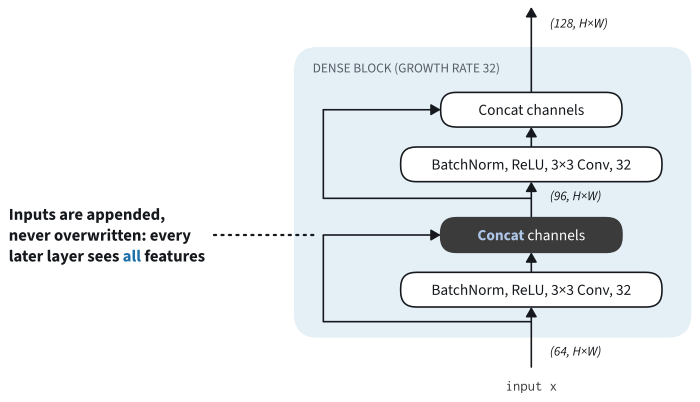
加算 \mathbf{x}_k = \mathbf{x}_{k-1} + g_k(\mathbf{x}_{k-1}) の代わりに、DenseNet(Huang et al., 2017)は各層の成長率 r チャネルの出力を先行するすべての特徴マップに連結する
- 明示的な特徴の再利用: \mathbf{x}_k = [\mathbf{x}_{k-1},\; f_k(\mathbf{x}_{k-1})] n 層を c チャネル入力に適用するとテンソルは c + n r チャネルになり、密ブロック間の遷移層(1\times 1 畳み込み + 2\times 2 平均プーリング)が幅を圧縮する
- 実用上で加算型ショートカットが主流となった理由(メモリの落とし穴):素朴な DenseNet は誤差逆伝播のために幅 c + (i-1)r の新たな連結バッファを各層 i=1,\ldots,n で確保するため、\sum_{i=1}^n (c + (i-1)r) = nc + \frac{n(n-1)}{2}r = \Theta(n^2 r) の活性化メモリを要する(例:チャネル数は 10{,}368 対 ResNet の 3{,}072、ただし n=24, c=64, r=32)