def init_weights(self):
"""GPT-2's initialization of the linear layers: N(0, 0.02^2) weights and
zero biases; W_o and W_2, which write to the stream, get std
0.02 / sqrt(2L)."""
L = len(self.blks)
for name, m in self.named_modules():
if isinstance(m, nn.Linear):
std = 0.02 / (2 * L) ** 0.5 if name.endswith(
('W_o', 'W_2')) else 0.02
nn.init.normal_(m.weight, std=std)
if m.bias is not None:
nn.init.zeros_(m.bias)デコーダのみの言語モデル(GPT)
Dive into Deep Learning · §11.2
デコーダのみの言語モデル(GPT)
因果スタックと重み共有埋め込み・バイトレベル事前学習・SwiGLU と RNN ベースライン・サンプリング・GPT-2 の読み込み・現代的なレシピ
長さ T の単一ウィンドウによる T 個の予測問題の訓練
動機
- 自己回帰言語モデルは連鎖律 P(x_{1:T+1}) = \prod_{t=1}^T P(x_{t+1} \mid x_{1:t}) により系列の確率を分解する
- 並列な教師強制:T 回の別々の順伝播を長さ 1, \dots, T の各プレフィックスに対して実行する代わりに、デコーダのみの GPT は因果マスクのもとで全 T 個のプレフィックス予測のスコアを 1 回の並列順伝播で計算する
GPT アーキテクチャ:埋め込み、因果スタック、重み共有ヘッド
アーキテクチャの概要
- 入力埋め込み(\mathbf{E} \in \mathbb{R}^{V \times d}):離散トークン ID x_1, \dots, x_T を \mathbb{R}^{B \times T \times d} の初期残差ストリームベクトルへ写像する
- 因果 Transformer スタック(L ブロック):各
TransformerBlockが因果的自己アテンションと位置ごとの FFN をストリームに適用する - 最終正規化と重み共有出力ヘッド(\mathbf{E}^\top):正規化されたストリームベクトルを語彙ロジット \mathbf{Z} = \mathrm{Norm}(\mathbf{H}^{(L)})\mathbf{E}^\top \in \mathbb{R}^{B \times T \times V} へ射影し、\mathbf{E} を再利用して V d 個のパラメータ(GPT-2 Small で 38.6\text{M} 個)を節約する
RoPE と GQA を備えた融合型因果的自己アテンション
因果アテンション
- 融合 QKV 射影:\mathbf{X} に単一の行列 \mathbf{W}_{qkv} \in \mathbb{R}^{d \times (d + 2 H_{\text{kv}} d_h)} を掛け、H 個のクエリヘッドと H_{\text{kv}} \le H 個のキー・値ヘッドに分割する
- RoPE + 因果マスク(
is_causal=True):位置角度でクエリとキーを回転させ、s > t を -\infty にマスクして \partial \mathbf{z}_t / \partial \mathbf{x}_s = \mathbf{0} とする
位置情報:学習型テーブルと RoPE
位置エンコーディング
pos='learned'(GPT-2、2019):参照行 \mathbf{p}_t \in \mathbb{R}^d をpos_emb(T_{\max} \times d)から取り出してスタック最下部で一度だけ加算し、T_{\max} = 1{,}024 が厳密な上限となるpos='rope'(デフォルト / Llama / Qwen):事前計算したd2l.rope_tables(T, head_width)を用いてすべてのアテンション層の内部で (\mathbf{q}_t, \mathbf{k}_s) を回転させ、32\text{K}〜1\text{M} トークンまでスケールする相対スコアを与える
10 行で書く GPT の完全な順伝播
順伝播の実装
トークン ID X(形状 (batch, T))が与えられると、GPT.forward はすべての位置における次トークンのロジット(形状 (batch, T, V))を同時に返す。
def forward(self, X):                     # X: (batch, T) token ids
    H, tables = self.token_emb(X), None   # (batch, T, d)
    if self.pos == 'learned':
        H = H + self.pos_emb(torch.arange(X.shape[1], device=X.device))
    else:  # RoPE cosine/sine tables for positions 0, ..., T - 1
        tables = d2l.rope_tables(X.shape[1], self.head_width, device=X.device)
    for blk in self.blks:                 # L pre-norm causal Transformer blocks
        H = blk(H, tables=tables)
    return F.linear(self.norm(H), self.token_emb.weight)  # Weight-tied (batch, T, V)
出力射影を self.token_emb.weight と重み共有することで、希少なトークンは入力プレフィックスに現れたときと、ソフトマックスの分母で対比されたときの両方で勾配更新を受ける。
深さに応じた重みのスケーリング初期化(1/√(2L))
初期化
init_weightsは埋め込みと射影を \mathcal{N}(0, 0.02^2) からサンプリングし、2 つの残差書き込み行列(W_o、W_2)を 1/\sqrt{2L} 倍にスケーリングする- 2L 個のサブ層が Pre-Norm ストリームへ書き込むため、ブロック 1 以降も初期ストリームの分散が埋め込みの分散付近に保たれる
自己回帰の交差エントロピー目的関数
訓練の目的関数
入力ウィンドウ \mathbf{x} = (x_1, \dots, x_T) とシフトされたターゲット \mathbf{y} = (x_2, \dots, x_{T+1}) が与えられたとき、訓練では全 B \times T 個の位置にわたる平均の負の対数尤度を最小化する。
\mathcal{L}(\boldsymbol{\theta}) = -\frac{1}{BT} \sum_{b=1}^{B} \sum_{t=1}^{T} \log \mathrm{softmax}\bigl(\mathbf{z}_{b,t}(\boldsymbol{\theta})\bigr)_{x_{b, t+1}}
X[0]: 'the European lobster ) a'
Y[0]: 'he European lobster ) an'
[[1 0 0 0 0]
 [1 1 0 0 0]
 [1 1 1 0 0]
 [1 1 1 1 0]
 [1 1 1 1 1]]
WikiText-103 におけるバイトレベル言語モデリング
コーパスと初期化の確認
6 ブロックのバイトレベル GPT(V = 256, d = 256, H = 8, L = 6, T = 128、4.79\text{M} パラメータ)を、WikiText-103 の生の UTF-8 バイト列(270\text{M} バイト)上で訓練する。
270M training bytes, 1.14M validation bytes, vocabulary of 2564.79M parameters; loss before training 5.66 nats per byte, log 256 = 5.55訓練前の妥当性確認:ステップ 0 では、ランダムなロジットがすべてのバイトにほぼ一様な確率 1/256 を割り当てるため、初期損失(5.5\text{--}5.7\text{ nats/byte})は \ln 256 \approx 5.55\text{ nats/byte} に近くなる。
現代的な事前学習オプティマイザ(LMOptimizer)
最適化レシピ
LMOptimizerは AdamW(\eta_{\max} = 2 \times 10^{-3})、線形ウォームアップ + コサイン減衰、および大域的勾配クリッピング(\le 1.0)を組み合わせる。 \eta_t = \eta_{\max} \cdot \frac{1}{2}\Bigl(1 + \cos\bigl(\pi \tfrac{t - t_w}{S - t_w}\bigr)\Bigr)- 選択的重み減衰(2D 行列のみに \lambda = 0.1):埋め込み(
*emb*)、1D のRMSNormゲイン、およびバイアスを対象外とする
訓練曲線と経験エントロピーの基準値
訓練結果
- 急速な収束:1{,}000 ステップ(8.2\text{M} バイト、コーパスの \sim 3\%)で、検証交差エントロピーは \approx 5.6 から 1.34\text{ nats/byte}(\approx 1.93\text{ bits/byte})まで低下する
- 同じバイト列上のカウントベース基準値:
- 一様予測(\ln 256):5.55\text{ nats/byte}
- 経験ユニグラム頻度:3.17\text{ nats/byte}
- 経験バイグラム遷移:2.45\text{ nats/byte}
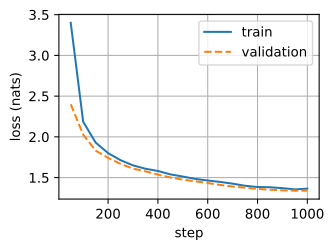
step 1000: train 1.36, validation 1.34 nats per byte; 14 s of training訓練曲線と経験エントロピーの基準値(続き)
訓練結果
ユニグラムとバイグラムの基準値は、訓練データの先頭 10\text{M} バイトに対する単純な出現回数から求める。
text = data.train[:10**7].astype(np.int64)  # The first 10M training bytes
V = len(data.vocab)
unigram = np.bincount(text, minlength=V) / len(text)
pairs = np.bincount(text[:-1] * V + text[1:], minlength=V * V).reshape(V, V)
bigram = pairs / np.maximum(pairs.sum(1, keepdims=True), 1)
p = unigram[unigram > 0]
print(f'unigram {-(p * np.log(p)).sum():.2f}, '
      f'bigram {-np.log(bigram[text[:-1], text[1:]]).mean():.2f} '
      f'nats per byte')
unigram 3.17, bigram 2.45 nats per byte統制アブレーション:シード間のばらつきと SwiGLU の利得
実験の厳密性
純粋なアーキテクチャ上の改善をランダム初期化のノイズと区別するため、act='swiglu' を独立な 3 つのシードで、パラメータ数を揃えた act='gelu' を 3 つのシードで訓練する。
swiglu (4,788,992 parameters): validation 1.339, 1.344, 1.343; mean 1.342, range 0.005
gelu (4,787,456 parameters): validation 1.402, 1.402, 1.402; mean 1.402, range 0.000- 高い実行間の再現性:3 つの乱数シード間で、検証損失のばらつきは 0.01\text{ nats/byte} 未満に収まる
- 統計的に明確な
SwiGLUの優位性:同一のパラメータ数(4.79\text{M})とステップ時間で、SwiGLUはGELUを \sim 0.06\text{ nats/byte}(シード間のばらつきの > 5\times)上回る - Post-Norm 条件:同じ 100 ステップのウォームアップまたはウォームアップなしの
pre_norm=Falseブロックは、ユニグラムエントロピーである 3.17\text{ nats/byte} で止まる。サブ層の出力が正規化されたストリームよりも大きく成長し、全トークンが同じベクトルに行き着いて訓練が回復しないためである。500 ステップのウォームアップでは Post-Norm も約 1.38 まで訓練でき、Pre-Norm(1.34)にわずかに遅れる程度となる。
パラメータ数を揃えたリカレントモデルとの比較
Transformer と RNNLM
パラメータ数を揃えた d2l.RNNLM(d_{\text{rnn}} = 1{,}920、4.74\text{M} パラメータ)を 3 通りの学習率で訓練し、ウィンドウ位置 t \in \{0, 1, 4, 16, 64, 127\} ごとの検証損失を調べる。
RNN (4,739,072 parameters), peak rate 0.001: validation 1.461, 1.461
RNN (4,739,072 parameters), peak rate 0.002: validation 1.474, 1.459
RNN (4,739,072 parameters), peak rate 0.004: validation 1.548, 1.649
validation loss at positions 0, 1, 4, 16, 64, 127
     GPT: 2.47 2.15 1.49 1.33 1.33 1.30; 14.1 ms per training step
best RNN: 2.49 2.15 1.56 1.45 1.45 1.44; 10.6 ms per training step
なぜ文脈位置 t とともに差が広がるか:t = 0(文脈 1 バイト)では、両モデルのスコアは約 2.5\text{ nats}(バイグラムの下限は 2.45)である。t = 16 \dots 127 になると、RNN は約 1.4\text{ nats} で頭打ちになる(履歴を t 回の逐次的な \tanh ステップに押し込める必要があるため)のに対し、GPT は任意の先行バイトへ O(1) ホップで直接アテンションを向ける(約 1.3\text{ nats})。
自己回帰デコーディング:温度と Top-k
サンプリングの仕組み
- 各デコードステップで、
GPT.generateはロジット \mathbf{z}_t \in \mathbb{R}^V を温度 \tau > 0 でスケーリングし、top-k 候補に打ち切る。 p_v = \frac{\exp(z_{t,v} / \tau)}{\sum_{u \in \mathcal{V}_k} \exp(z_{t,u} / \tau)}
自己回帰デコーディング:温度と Top-k(続き)
サンプリングの仕組み
\tau = 0.7, k = 8 では自然な英単語に確率質量が集中するのに対し、\tau = 2.0 では分布が平坦化して意味不明な文字列に近づく。
T=1.0, top_k=None: 'The history of the 2010 lead in Cecil . The shiwn trees
    about his improvement appearances helped attack actual film songs , were
    aportimely'
T=0.7, top_k=8: 'The history of the story to the ship wife . \n = = =
    Control = = = \n The contrast of the final part of the time , and
    interviewers , and the'
T=2.0, top_k=None: 'The history of the
    lar��\u038d\u038d���Е�;v���ױ����岙��Ӄ�\x1c,ϐ \n
    Trenreodoviti��Ě�\x08q���nve VS ÷tu KopaxodSq ;
    �t3nĀohjnetoKcckakizonþon U�6'
事前学習済み OpenAI GPT-2 Small(124M)の読み込み
チェックポイントの読み込み
落とし穴:PyTorch における Conv1D 重みの転置
重み配置の落とし穴
OpenAI の元の TensorFlow 版 GPT-2 コードは Conv1D 層を用いて重み行列を (in_features, out_features) として格納していたのに対し、PyTorch の nn.Linear は (out_features, in_features) として格納する。
for i, blk in enumerate(gpt2.blks):
    modules = {f'h.{i}.ln_1': blk.norm1, f'h.{i}.ln_2': blk.norm2,
               f'h.{i}.attn.c_attn': blk.attention.W_qkv,
               f'h.{i}.attn.c_proj': blk.attention.W_o,
               f'h.{i}.mlp.c_fc': blk.ffn.W_1, f'h.{i}.mlp.c_proj': blk.ffn.W_2}
    for key, module in modules.items():
        W = weights[key + '.weight']                # Conv1D layout: (in, out)
        module.weight.copy_(W.T if W.ndim == 2 else W)  # Transpose 2D matrices
module.bias.copy_(weights[key + '.bias'])サイレントバグの危険性:c_proj は正方形状 (768, 768) をもつため、.T を忘れてもすべての形状アサーションをエラーなしに通過してしまう。転置された行列を検出できるのは、実際のテキストに対するパープレキシティの確認だけである。
パープレキシティとテキスト生成による GPT-2 Small の検証
チェックポイントの検証
読み込んだ 124.4M パラメータの gpt2 モデルを『The Time Machine』上で評価すると、トークンあたりの交差エントロピーは 3.89\text{ nats}(パープレキシティは e^{3.89} \approx 49 であり、一様予測の 50{,}257 と対照的)となり、一貫性のある貪欲生成・サンプリング生成の続きが得られる。
text = ("The Time Machine, by H. G. Wells. The Time Traveller was "
        "expounding a recondite matter to us.")
x = torch.tensor(enc.encode(text), device=d2l.try_gpu())[None]
with torch.inference_mode():
    logits = gpt2(x)
loss = F.cross_entropy(logits[0, :-1], x[0, 1:])
print(f'per-token loss {loss.item():.2f}, '
      f'perplexity {loss.exp().item():.0f}')
per-token loss 3.89, perplexity 49GPT-2 Small による貪欲生成とサンプリング生成
チェックポイントの検証
Alan Turing theorized that computers would one day become the most powerful
    machines on the planet.

The computer is a computer that
The secret of a good deep learning textbook is that it can be read by
anyone. The easiest way to learn a deep learning language is to read the
book, or the software. It's also the easiest way to learn a framework.現代のオープンウェイト LLM のアーキテクチャレシピ
フロンティアモデルの比較
- 主要なすべてのオープンウェイト・デコーダのみのモデル族(2023〜2025 年)は、本節のデフォルト
GPTバックボーン(RMSNorm、RoPE、SwiGLU)を共有する - 差別化の 2 つのフロンティア軸:
- KV キャッシュ圧縮(§11.3):GQA(32{:}8 または 64{:}8)、5{:}1 の局所・大域ウィンドウ(Gemma 3)、または低ランク MLA(DeepSeek-V3)
- FFN のスパース性(§11.7):密な
SwiGLUと細粒度 MoE(128〜256 エキスパート)
概念チェック:パラメータ数、パープレキシティ、対称性
理解度チェック
3 つの具体的な計算で理解度を確かめよう。
- GPT-2 Medium のサイズ見積もり:GPT-2 Medium は L = 24 ブロック、幅 d = 1024、語彙数 V = 50{,}257、学習済み位置数 T_{\max} = 1024、および重み共有ヘッドをもつ。総パラメータ数を見積もれ。
- 実効分岐数としてのパープレキシティ:本節のバイトレベル GPT は 1.35\text{ nats/byte} に達し、GPT-2 Small は『The Time Machine』で 3.89\text{ nats/token} のスコアとなる。それぞれの損失は、等確率な選択肢が何通りあることに対応するか。
- 0 層での重み共有の落とし穴:
num_blks=0かつ \mathbf{E} のすべての行が単位ノルムをもつとき、どの次トークン x_{t+1} が \mathbf{z}_t = \mathbf{e}_{x_t}\mathbf{E}^\top で常に最大のロジットを得るか。
解答:
- \approx 355\text{M} パラメータ:ブロック内に 24 \times 12(1024)^2 \approx 302.0\text{M}、
token_embに + 50{,}257 \times 1024 \approx 51.5\text{M}、pos_embに + 1.0\text{M} - バイトモデルでは e^{1.35} \approx 3.9 バイト(全 256 通り中)、GPT-2 では e^{3.89} \approx 49 サブワードトークン(全 50{,}257 通り中)
- x_{t+1} = x_t(現在のトークンの繰り返し):対称なグラム行列 \mathbf{E}\mathbf{E}^\top は \mathbf{e}_i^\top \mathbf{e}_j を対角成分 j = i 上で最大化する。アテンションと FFN がこの対称性を破る。
まとめ:デコーダのみの GPT の構築と訓練
要点
- 因果スタックと重み共有ヘッド:融合された \mathbf{W}_{qkv}、RoPE、下三角マスク、および共有された \mathbf{E} \in \mathbb{R}^{V \times d} により、全 T 個のプレフィックス予測を 1 回のパスで訓練
1/√(2L)初期化とLMOptimizer:2D 行列のみの重み減衰とウォームアップ + コサイン減衰を備えた AdamW により、1.34\text{ nats/byte} に 1{,}000 ステップで到達- 統制されたベースラインと GPT-2 の読み込み:
SwiGLUがGELUを 0.06\text{ nats} 上回り、公式の124MGPT-2 を直接読み込み可能